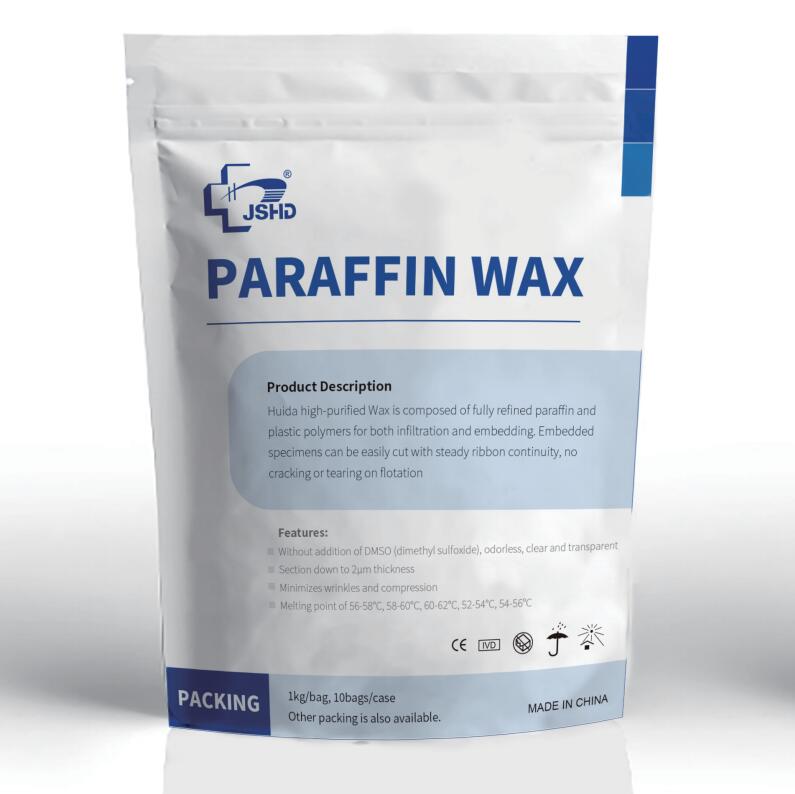
High-purity histology paraffin wax formulated for tissue infiltration, embedding and microtome sectioning. The refined paraffin and plastic polymer formulation supports tissue penetration, stable paraffin blocks and consistent ribbon formation during sectioning.
Paraffin wax in histology is used to infiltrate processed tissue and form a supportive block around the specimen. After the tissue has been fixed, dehydrated and cleared, molten histology wax penetrates the tissue spaces. The specimen can then be oriented in an embedding mold and allowed to solidify.
A stable paraffin block supports the specimen while thin sections are cut on a microtome. The quality of the wax influences tissue penetration, block handling, ribbon continuity and the appearance of sections during flotation.
Huida paraffin wax for histology combines fully refined paraffin with plastic polymers. The formulation is intended for both infiltration and embedding, helping laboratories maintain a consistent wax system throughout tissue preparation.
The formulation is developed to support the main stages of routine paraffin tissue processing, from molten wax infiltration to thin microtome sectioning.
Fully refined paraffin is combined with plastic polymers to improve embedding performance and support consistent handling of paraffin tissue blocks.
The wax is manufactured without the addition of dimethyl sulfoxide. It is clear, transparent and odorless under normal product conditions.
The wax supports precise histological sectioning down to approximately 2 μm when used with appropriate tissue processing, block preparation and microtome settings.
Properly embedded specimens can be sectioned with stable ribbon continuity, helping reduce cracking, tearing, wrinkles and compression.
Select the melting point range according to your laboratory procedure, tissue type, processing temperature and working environment.
| Specification | Available Information |
|---|---|
| Product type | Paraffin histology wax for laboratory use |
| Primary applications | Tissue infiltration, embedding and microtome sectioning |
| Composition | Fully refined paraffin combined with plastic polymers |
| Appearance | White, clear and transparent after melting |
| DMSO | Without added DMSO |
| Odor | Odorless |
| Section thickness | Supports sectioning down to approximately 2 μm |
| Melting point options | 52–54°C, 54–56°C, 56–58°C, 58–60°C and 60–62°C |
| Standard packing | 1 kg per bag, 10 bags per case |
| Custom packing | Available according to order requirements |
| Storage | Store below 38°C and protect from direct sunlight |
Huida supplies five melting point ranges so laboratories can select histology wax that fits their validated processing and embedding protocols.
Paraffin wax for microtome sectioning must provide enough support to hold the tissue securely without creating an excessively brittle or difficult-to-cut block. A correctly processed block should move evenly across the blade and produce sections that can form a continuous ribbon.
Huida histology paraffin wax is formulated to support sectioning down to approximately 2 μm. It helps limit cracking or tearing during sectioning and reduces wrinkles and compression when processing, embedding, blade condition and microtome settings are properly controlled.
Consistent results also depend on tissue fixation, dehydration, clearing, infiltration time, embedding orientation, block cooling, blade angle and sectioning speed. The wax should therefore be used as part of a complete, validated histology workflow.
The exact procedure should follow your laboratory's validated protocol. The following overview shows where histology paraffin wax fits into a standard paraffin-processing workflow.
Fixed tissue is dehydrated and cleared before paraffin infiltration. Water and incompatible processing liquids must be removed according to the laboratory protocol.
Molten paraffin penetrates the processed tissue and replaces the clearing medium. Temperature and infiltration time should be controlled to suit the specimen.
The infiltrated specimen is positioned in a mold with molten wax. Correct orientation is important because it determines the sectioning surface.
After cooling and solidification, the paraffin block is trimmed and sectioned. Thin sections are transferred to a water bath and then collected on microscope slides.
Huida recommends using the same paraffin wax during both infiltration and embedding. This helps avoid unnecessary differences between the wax surrounding the tissue and the wax forming the final block.
The molten histology wax is formulated to penetrate properly processed tissue during the infiltration stage.
During embedding, the wax surrounds the specimen and creates a stable block that supports tissue orientation and trimming.
Using one wax specification throughout the workflow can simplify process control and help laboratories maintain consistent block behavior.
The product is intended for laboratories that prepare paraffin tissue blocks and thin sections for microscopic examination.
Suitable for daily tissue infiltration, embedding and sectioning workflows using paraffin-processing methods.
Supports the preparation of stable tissue blocks and sections for subsequent staining and microscopic assessment.
Multiple melting point ranges allow researchers to select a wax specification suited to their established specimen-processing protocol.
Can be used in supervised histology training workflows covering infiltration, embedding, trimming and section preparation.
The wax can be melted and dispensed during routine manual embedding procedures according to laboratory operating instructions.
The appropriate melting range may be selected for compatible tissue-processing equipment and validated laboratory cycles.
Store the unopened paraffin wax below 38°C in a dry area protected from direct sunlight. Avoid placing the bags near heating equipment, windows, steam lines or other locations where the storage temperature may rise.
Paraffin wax may cake or stick together when exposed to elevated temperatures during storage or transportation. Caking does not necessarily prevent use because the wax will be melted during the normal histology procedure.
Laboratories should follow their own safety procedures when melting and handling hot paraffin. Keep the work area clean and avoid mixing the wax with water, clearing agents, used wax or unrelated materials.
The standard packaging is 1 kg of histology paraffin wax per bag, with 10 bags packed in each case. The individual bags help laboratories organize inventory and open only the quantity required for their current workload.
Customized packaging can also be discussed according to order quantity, destination market and project requirements. Buyers should provide the required bag size, carton quantity, label content and branding requirements when requesting a quotation.
| Packing Level | Standard Configuration |
|---|---|
| Inner bag | 1 kg per bag |
| Outer case | 10 bags per case |
| Total net weight | 10 kg per standard case |
| Customized packing | Available subject to project confirmation |
Providing complete specifications helps the sales team confirm the correct product and prepare an accurate quotation.
Specify 52–54°C, 54–56°C, 56–58°C, 58–60°C or 60–62°C.
Provide the number of bags, cartons or total kilograms required.
Confirm whether standard 1 kg bags or customized packaging is required.
Include the destination country or port so suitable shipping details can be discussed.
Paraffin wax is used to infiltrate processed tissue and form a supportive embedding block. The solid block holds the specimen in position while thin sections are cut with a microtome.
Yes. Huida recommends using the same paraffin wax for both infiltration and embedding to maintain a more consistent wax system throughout the tissue-preparation workflow.
Available melting point ranges are 52–54°C, 54–56°C, 56–58°C, 58–60°C and 60–62°C.
The choice depends on the laboratory protocol, tissue type, processing temperature, ambient conditions and preferred sectioning characteristics. Confirm the required range with your laboratory or technical team before ordering.
Yes. It is formulated for paraffin tissue embedding and microtome sectioning. Under suitable processing and sectioning conditions, it supports sections down to approximately 2 μm.
No added DMSO is used in the product formulation. The wax is described as odorless, clear and transparent.
The standard packaging is 1 kg per bag and 10 bags per case, providing a total net wax weight of 10 kg per standard case.
Customized packaging can be discussed according to the order quantity and project requirements. Include the required bag size, carton configuration and label details in your inquiry.
Store the wax below 38°C and protect it from direct sunlight. Keep unopened bags in a clean, dry storage area away from heat sources.
The wax may cake when stored at elevated temperatures. The product page states that this caking does not affect normal use because the paraffin will be melted during processing.
Send the required melting point, quantity, packaging, destination and any customization requirements through the Huida contact page or email info@chinahuida.cn.
Tell us your preferred melting point, required quantity, packaging specification and delivery destination. Our team will help you confirm the appropriate histology wax configuration for your laboratory workflow.